
What Is a Phinisi?
Born from the forest. Destined for the sea.
A phinisi is a traditional Indonesian wooden sailing ship, built by hand in South Sulawesi. WAOW 2 is one of them. This is how she is being built.
A traditional Indonesian sailing ship
A phinisi is a traditional Indonesian wooden sailing ship. These ships are built by hand by the shipwrights of South Sulawesi, a craft passed down from generation to generation by the Bugis master shipbuilders. Five things set them apart:
- Built without formal blueprints. Master shipbuilders rely on generations of inherited knowledge, proportions and experience. The hull is shaped by eye and tradition rather than computer design, which makes each boat slightly unique.
- The hull comes before the frames. In most Western shipbuilding the skeleton is built first. Here the outer planking is assembled early, and the frames are fitted afterwards to reinforce the shape. It is one of the most distinctive aspects of Sulawesi boatbuilding.
- A boat is considered alive. In Bugis and Konjo maritime culture, a boat is not just an object. Important steps of the construction, such as laying the keel, come with ceremonies and offerings asking for protection and safe voyages.
- The name refers to the rig, not the hull. Strictly speaking, “phinisi” first meant a two-masted sailing rig. The hull belongs to a type of traditional vessel called “palari”. Over time, the word came to describe the whole ship.
- Built by hand. Shipwrights shape massive hardwood beams and planks by eye, with planes, chisels, mallets, long augers and chalk strings, and even use fire and water to bend the wood. No CAD, no automation.
From our journal: five facts about the phinisi (April 2026) and the tools that build WAOW 2 (March 2026).
Bira and Haji Wahab
WAOW 2 is being built in Bira, in the province of South Sulawesi, a place known for its white sand beaches and its shipbuilders.
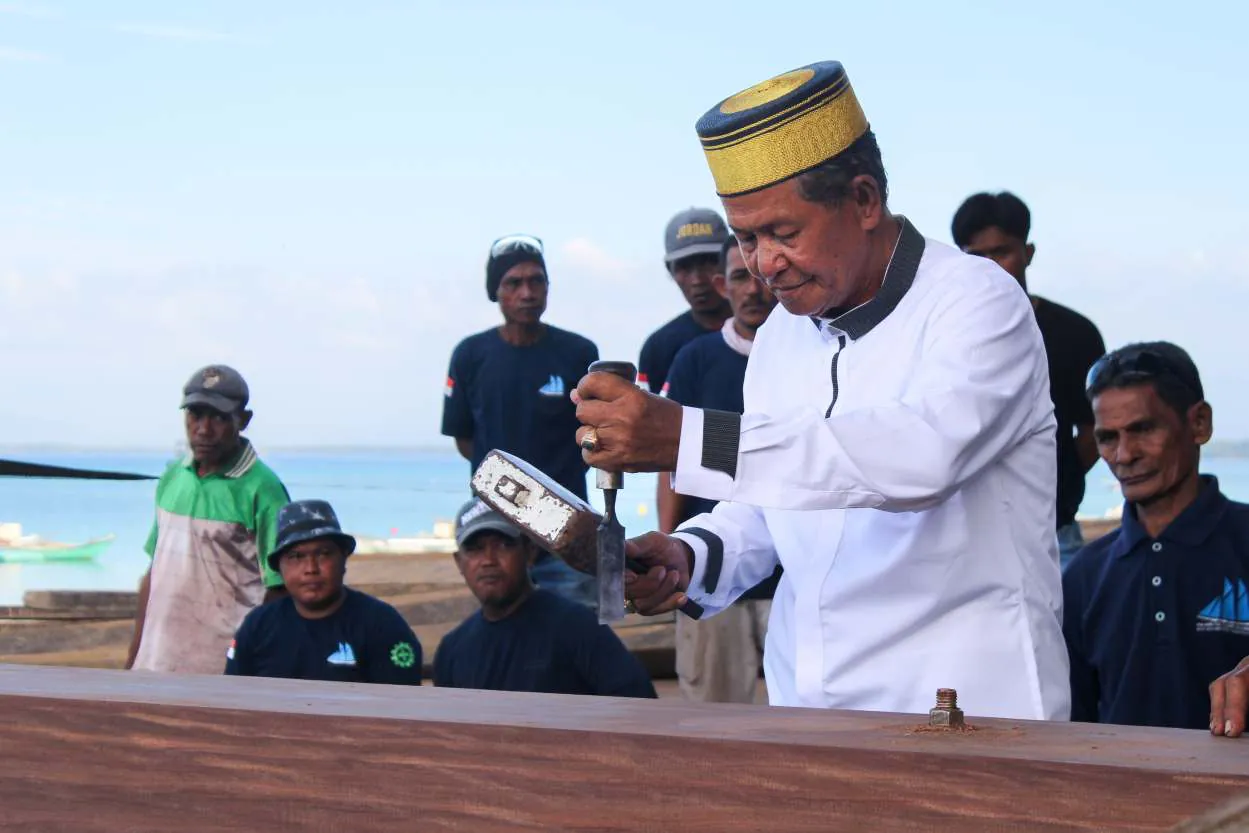
Her builder is Haji Wahab, the panrita lopi, or master builder, of the shipyard: a legend of phinisi shipbuilding and the reference of his generation. He built the first WAOW, and he is building WAOW 2 with his son Rahmat and his team of craftsmen, with skills passed down through generations of Indonesian artisans.
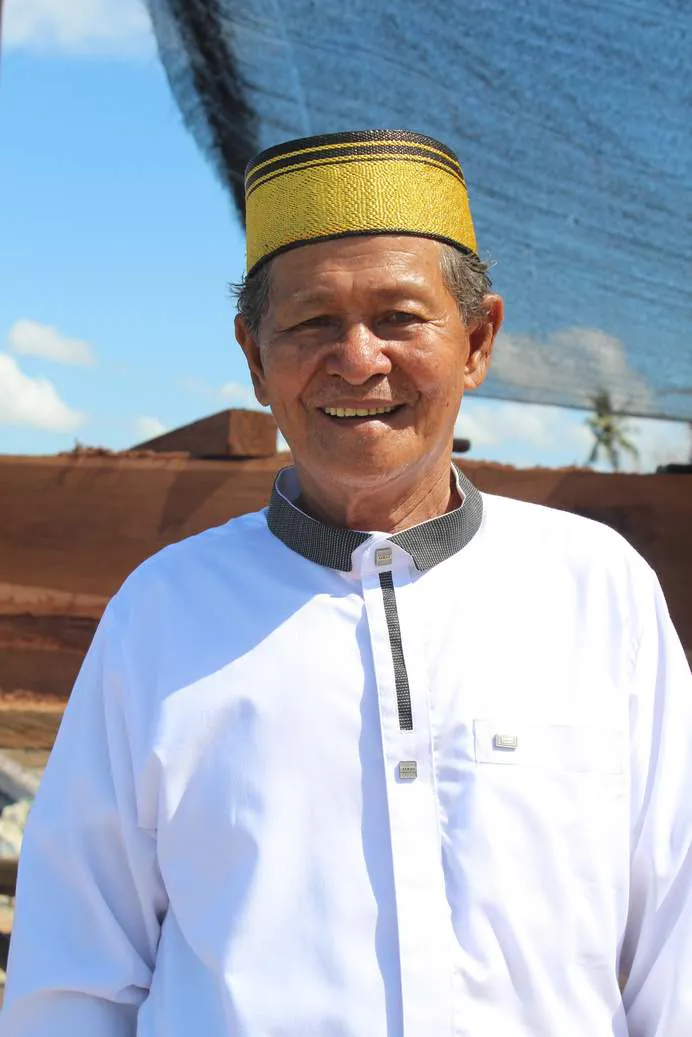
From our journal: Master Haji Wahab (October 2025) and the craftsmen of WAOW 2 (August 2026).
Ironwood and teak
WAOW 2 has ironwood frames and teak decks.
Ironwood, or ulin, has been the heart of traditional Indonesian boatbuilding for centuries. It is dense and strong, and withstands decades of waves, rain and salt. Its tight grain and natural oils protect it from decay, fungi and marine borers. The finest ulin comes from Kendari in Southeast Sulawesi. Master builders use it for the keel, the ship’s spine, and on WAOW 2 almost everything is shaped from it: planks, ribs, the inner framework and the superstructure.
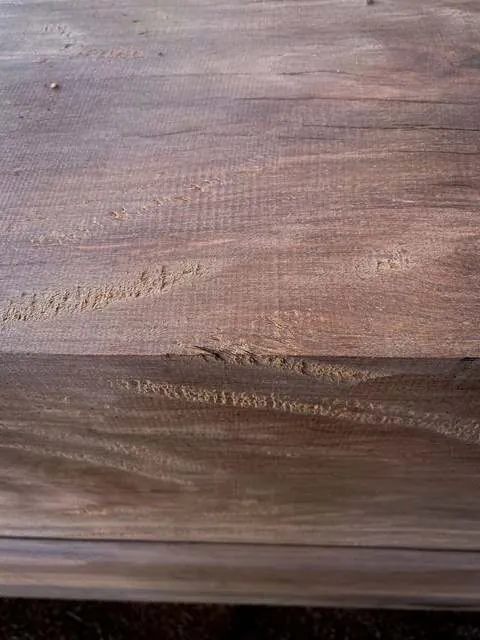
The seams between the planks are caulked by hand, with fibres from the bark of the Gelam tree (Melaleuca cajuputi) driven in with a mallet and a caulking iron, then sealed with a protective compound.
Building WAOW 2 takes a considerable amount of wood. To give back, we work with Good Forest Indonesia to plant and restore Indonesian forests: read more.
From our journal: WAOW 2 and her wood (November 2025) and caulking (April 2026).
How WAOW 2 is being built
Construction began in Bira in September 2025. Step by step, as told in our monthly journal:
- September 2025: the keel. On 18 September 2025, the keel ceremony took place at the shipyard on Bira Beach. The Songkobala ritual, rooted in Bugis tradition, is a sacred act of blessing and purification. Haji Wahab cuts a notch in the keel in three places, at the rudderstock, the bow and the centre, to mark the true start of construction, and hides two pieces of gold inside it. Keel laying ceremony
- October 2025: stem, sternpost and ribs. One month after the keel laying, the hull already rises from the building site, and the stem, the sternpost and the first ribs are being installed. Shipyard visit
- Until December 2025: the first planks. The planking is fixed directly to the keel and the end pieces, each plank fitted by hand, without detailed plans. Technical focus: the hull
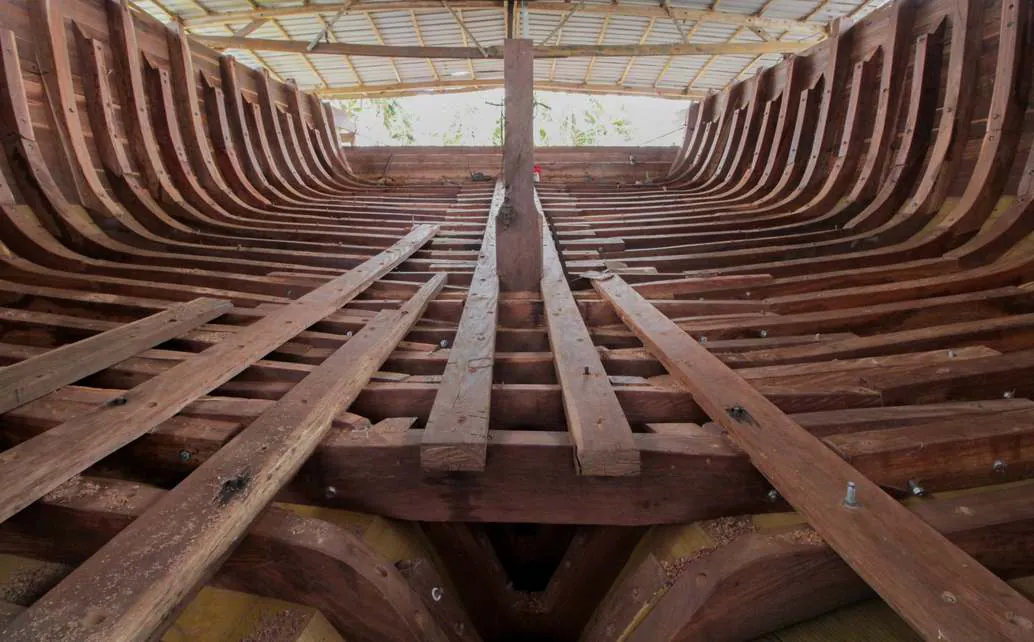
- February 2026: ribs and keelson. Each rib is adjusted and secured with large bolts through the keel structure. The keelson, a massive beam above the keel, locks the structure together, the transom is planked and the bow begins to rise. Shipyard visit
- By April 2026: the hull. Ribs, stringers and planking come together and reveal her flowing lines, and the seams are caulked by hand. Shipyard progress
- By June 2026: the main deck. The deck beams are installed one by one, each shaped to the curve that lets water drain, and the first frames of the deckhouse rise. Technical focus: main deck
- By August 2026: railing and layout. The railing takes shape around the main deck, and with the architect we plan every corner of the main and lower decks. Latest news from the shipyard
- September 2026: one year in Bira. The upper deck is in place. On the main deck, two cabins, the restaurant and lounge, the dive shop, the camera room, the galley and the outdoor spaces begin to find their place. The lower deck is divided into two levels for the deluxe cabins, the engine room, the crew quarters and the tank deck. One year around the corner
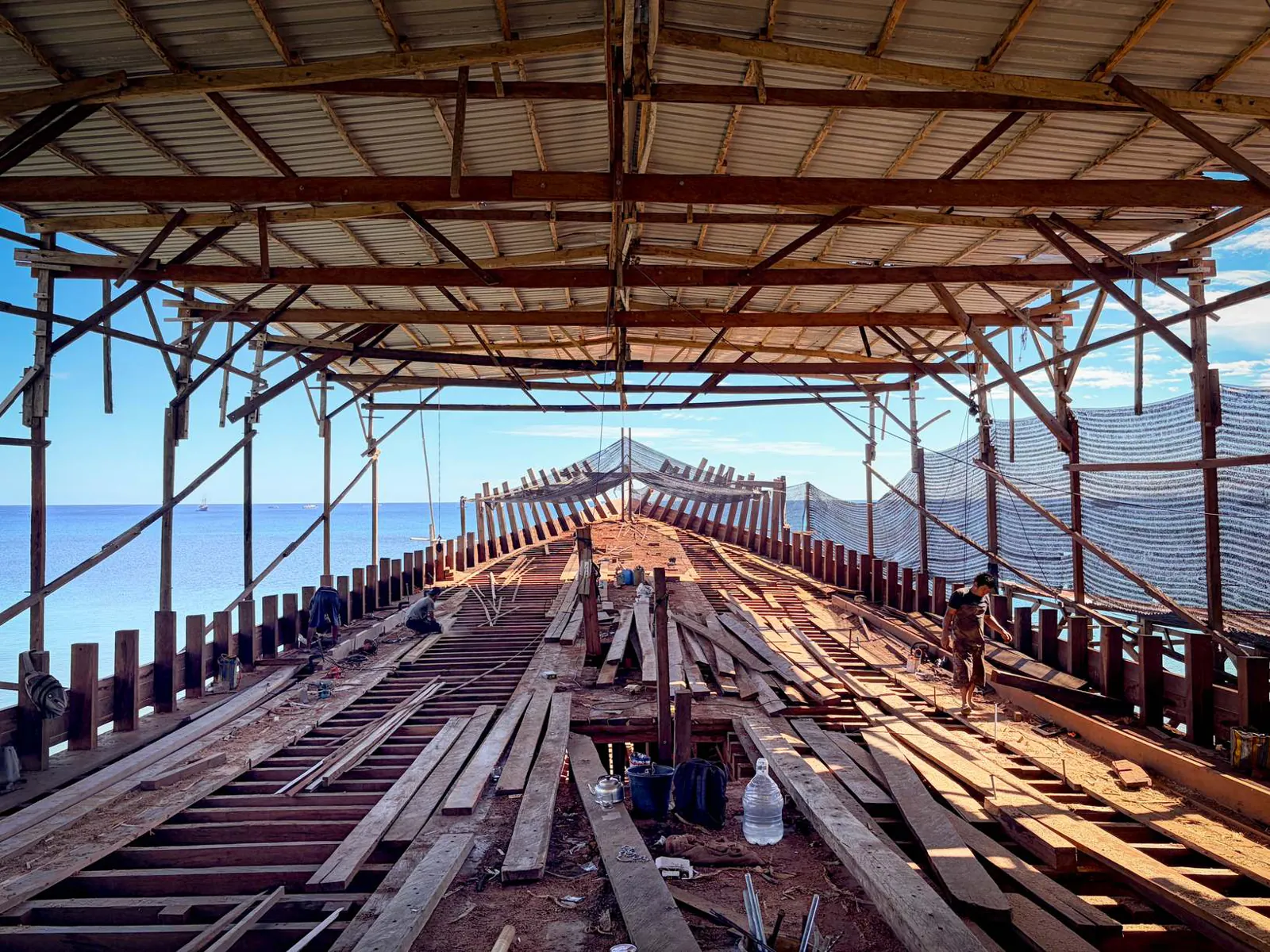
Next, on the provisional timeline: the launch and the start of fitting out in summer 2027, the masts in spring 2028 and sea trials in summer 2028. WAOW 2 is set to sail in October 2028.
The first WAOW
WAOW 2 is not our first phinisi. The first WAOW was drawn by Swiss diver Michel Deville and built over four years by Haji Wahab and his team of Indonesian shipwrights. Inspired by the Indonesian phinisi and combined with the lines of a schooner, she measured 60 metres, with 3 masts, 900 m² of sails and more than 850 tonnes. She welcomed her first guests in April 2012 and sailed Indonesia until the night of January 31 to February 1, 2018, when she caught fire in the port of Biak and was lost. Everyone on board made it to safety.
In Michel’s words, WAOW 2 is her faithful twin, with just a few small touches of her own. Visit the WAOW Museum or meet WAOW 2: 60 metres, 11 cabins, 20 guests and more than 20 crew.